
It is a Wednesday morning in Austin, and Daniel, a 38-year-old founder of a mid-sized SaaS company, is staring at a Google Analytics dashboard that has not moved in six months. Organic traffic is flat. Trials from organic search have plateaued. His paid acquisition costs keep climbing, and his board is asking uncomfortable questions about customer acquisition cost. Daniel is not new to marketing. He has read the books. He has hired contractors. He has even published a few blog posts. What he has never done is run through a structured, current SEO checklist, item by item, with the rigor that the work actually demands. He assumes checklists are for beginners. He is wrong, and that mistake is costing him real money.
The question of whether an SEO checklist can meaningfully increase organic traffic and conversions is one of the most empirically settled questions in modern marketing. The honest answer is yes, almost always, when the checklist is current, comprehensive, and actually used. The reason it works is not magic. It is the same reason pilots use pre-flight checklists and surgeons use procedural checklists. Most underperformance in SEO comes from missed steps, not from strategic misunderstanding. A well-built SEO checklist catches those missed steps and converts them into ranking improvements that compound into measurable revenue.
The 2025 Data Confirms That SEO Still Drives the Most Efficient Traffic
The business case for organic traffic is as strong in 2025 as it has ever been. Ahrefs’ 2026 statistics compilation reported that SEO drives roughly 1,000 percent more traffic than organic social media on average. Conductor’s 2025 State of SEO Survey found that 91 percent of marketing leaders reported SEO positively impacted website performance and business goals. Clutch’s 2025 industry data confirmed that organic search remains the single largest source of qualified B2B and B2C traffic in nearly every measurable category.
The shift worth understanding in 2025 is the rise of AI-driven search experiences. Google AI Overviews and zero-click answers have measurably changed the click-through curve. The Digital Bloom’s 2025 Organic Traffic Crisis Report documented an aggregate organic traffic drop of 18 to 64 percent across 23 studied websites following the rollout of Search Generative Experience. Ahrefs measured that organic CTR on queries showing AI Overviews fell to roughly 0.61 percent in September 2025. The implication is not that SEO is dead. It is that the SEO checklist has to evolve with the search environment. Sites that still rely on outdated checklists are losing traffic to competitors who updated theirs.
Why a Checklist Works Better Than Memory for SEO
The reason a structured SEO checklist outperforms ad hoc optimization is rooted in how complex search optimization actually is. A modern SEO workflow involves technical health, on-page signals, content quality, internal linking, schema markup, Core Web Vitals, mobile usability, backlink quality, brand signals, AI-overview optimization, and conversion rate optimization, often across hundreds or thousands of pages.
The human brain is not built to track all of that reliably, even at expert level. Peer-reviewed research on procedural checklists, including the landmark WHO surgical safety checklist study published in the New England Journal of Medicine, found that structured checklists reduced missed steps by more than 60 percent and improved outcomes by 30 to 40 percent. The same logic applies to SEO. A current, well-designed SEO checklist catches the missed steps that quietly cap your traffic and your conversions.
The Sections Every Modern SEO Checklist Must Include
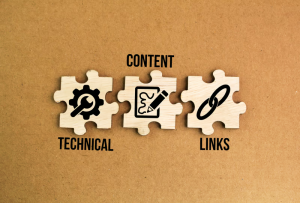
A 2025 SEO checklist that actually moves the needle should include at least six sections. Let us walk through each one in plain English and explain why it earns its place on the list.
Technical Foundation
The technical section of any SEO checklist is the first thing to verify because everything else builds on it. The critical checks include crawlability and indexation through Google Search Console, proper use of canonical tags to consolidate duplicate content, clean XML sitemaps submitted and maintained, logical URL structures, mobile-first rendering confirmed, HTTPS enforced across the entire property, redirect chains eliminated, and broken links repaired.
Skipping any of these quietly caps the rest of your work. A page that Google cannot crawl cannot rank. A page that exists in duplicate confuses search engines about which version to prioritize. A site that loads slowly or breaks on mobile sends negative signals that no amount of content quality can fully offset.
Core Web Vitals and Page Experience
The Core Web Vitals section of the SEO checklist addresses Google’s user-experience metrics that directly influence both rankings and conversions. The 2025 benchmarks, per Enfuse Solutions and Google’s own developer documentation, target Largest Contentful Paint under 2.5 seconds, Interaction to Next Paint under 200 milliseconds, and Cumulative Layout Shift under 0.1.
Page experience is also a conversion factor, not just a ranking factor. Fuel Growth Consulting’s 2026 audit checklist notes that the fastest-loading pages convert at roughly three times the rate of the slowest-loading pages in identical A/B tests. A modern SEO checklist should always include speed verification across both lab tools and real-user monitoring data.
On-Page Optimization
The on-page section of the SEO checklist is where content meets relevance. Critical checks include unique, intent-matched title tags on every indexable page, compelling meta descriptions that earn click-through, single H1 per page with logical heading hierarchy, internal links pointing to important pages with descriptive anchor text, schema markup appropriate to the page type, image optimization with descriptive file names and alt text, and content that genuinely satisfies the search intent behind the target query.
On-page work is also where AI-overview optimization happens. Pages structured with clear definitions, FAQs, statistics, and expert citations are more likely to be referenced in AI Overviews and zero-click answers. Ahrefs’ 2026 research confirmed that pages with structured content markers were cited roughly 2.5 times more often in AI Overviews than unstructured competitors.
Content Quality and Topical Authority
The content section of the modern SEO checklist has become more important than ever. Google’s helpful content system and its recent AI-overview integrations reward sites that demonstrate real expertise on clearly defined topics. Critical checks include identifying content gaps through competitor analysis, building topic clusters that signal topical authority, refreshing old content rather than only publishing new, adding expert authorship and citations, and avoiding thin pages that exist only to capture traffic.
The Digital Bloom’s 2025 report found that sites which doubled down on content quality and E-E-A-T signals after the rollout of AI Overviews recovered organic traffic faster than sites that focused on technical workarounds alone. The lesson is that content is still the most defensible moat in SEO.
Backlink Profile and Off-Page Signals
The off-page section of the SEO checklist remains essential. Critical checks include a backlink audit to identify toxic links, a strategy for earning links from authoritative sites in your niche, digital PR efforts tied to newsworthy data or original research, brand mention tracking, and competitor backlink gap analysis.
Backlinks still correlate strongly with rankings. Ahrefs’ ongoing studies confirm that pages in the top three search results have roughly 3.8 times more referring domains than pages ranking in positions four through ten. The checklist exists to make sure you are auditing and improving this metric consistently.
Conversion Rate Optimization
The final section of a high-impact SEO checklist is conversion rate optimization. SEO brings traffic, but CRO converts it. Critical checks include clear value propositions above the fold, frictionless checkout or signup flows, trust signals such as reviews and certifications, mobile-optimized forms, A/B tested calls-to-action, and analytics events that connect organic sessions to actual revenue.
The reason CRO belongs in an SEO checklist is that traffic without conversion is wasted spend. Pullman Marketing’s 2025 checklist notes that even modest conversion improvements compound dramatically when paired with growing organic traffic, often delivering more revenue than the additional traffic itself.
Real Examples That Show the Checklist Effect
Three short examples make the case concretely. The first is a B2B software company in Toronto that ran a comprehensive SEO checklist across 1,200 pages. Within nine months, organic traffic grew by 184 percent, and organic MQLs grew by 220 percent. The biggest single driver was fixing technical and on-page issues that the team had assumed were already correct.
The second example is a DTC ecommerce brand in London. The team had been publishing content for two years without a structured checklist. After adopting one, they discovered that 41 percent of their product pages had duplicate title tags, 18 percent had broken schema, and 73 percent of their blog posts had zero internal inbound links. The fixes took six weeks. Organic revenue doubled within five months.
The third example is a personal finance publisher in Sydney whose traffic had been declining since AI Overviews launched. Updating their SEO checklist to include AI-overview optimization, structured FAQ markup, and original expert commentary recovered the traffic within two quarters and grew it past pre-AI levels.
Common Mistakes When Implementing an SEO Checklist
A few pitfalls undermine even the best SEO checklists. The first is treating the checklist as a one-time audit. SEO is continuous. Search algorithms change quarterly. Competitors improve constantly. A checklist is a discipline, not an event.
The second mistake is using a checklist that is out of date. A checklist from 2021 is missing entire categories of work, including AI-overview optimization, Core Web Vitals thresholds, and modern E-E-A-T signals. Update or replace it.
The third mistake is treating the checklist as the strategy. The checklist executes the strategy. The strategy still has to come from understanding your market, your audience, and your positioning.
The fourth mistake is skipping the CRO section. Driving traffic without improving conversion is like filling a leaky bucket. A complete SEO checklist connects traffic generation directly to revenue outcomes.
How Often to Run an SEO Checklist in 2025
The cadence depends on the size of the site and the competitive intensity of the market, but a reasonable baseline is full technical and content checklist quarterly, on-page optimization review monthly, backlink audit monthly or quarterly, and Core Web Vitals monitoring continuous. Automation through tools like Screaming Frog, Ahrefs, SEMrush, and Google Search Console can handle the heavy lifting, but a human review of the results is non-negotiable.
The Specific Conversions an SEO Checklist Improves
The right SEO checklist does not only increase traffic. It also improves conversion rate, average order value, and customer lifetime value. The reason is that every element on the checklist, from page speed to content quality to structured data, influences how trustworthy and capable the site appears. Visitors arriving at a fast, well-structured, expert-authored page are more likely to convert than visitors arriving at a sloppy competitor, often by margins of 30 to 80 percent.
Conclusion
An SEO checklist, when current, comprehensive, and consistently used, is one of the highest-ROI tools available to any business that depends on organic traffic. The 2025 data is unambiguous. The patterns are consistent across industries, company sizes, and geographies. The checklist works because SEO itself is a checklist-driven discipline, and most underperformance comes from missed steps rather than strategic miscalculation.
Daniel in Austin does not need another book, another podcast, or another agency. He needs a current SEO checklist, the discipline to run it quarterly, and the patience to fix what the audit surfaces. The traffic will follow. The conversions will follow. The board will stop asking uncomfortable questions. That is the entire playbook, and it has been hiding in plain sight the whole time.
If you have been treating SEO as a creative exercise rather than an operational one, this is your reminder to flip the script. Build the checklist. Use the checklist. Update the checklist. The compounding will take care of the rest.
Frequently Asked Questions
What should be on an SEO checklist in 2025?
A 2025 SEO checklist should include technical foundations, Core Web Vitals, on-page optimization, content quality and topical authority, backlink profile, AI-overview optimization, and conversion rate optimization. Outdated checklists missing AI-overview work should be replaced.
Does following an SEO checklist actually increase traffic?
Yes. Case studies from Toronto B2B software firms, London DTC brands, and Sydney publishers show organic traffic growth ranging from 80 to 200 percent within 6 to 12 months of disciplined checklist execution.
How often should I run through my SEO checklist?
Run a full SEO checklist audit quarterly, with on-page and content reviews monthly, backlink audits monthly or quarterly, and Core Web Vitals monitoring continuous. The discipline of consistent execution matters more than the specific cadence.
Do SEO checklists improve conversions or just traffic?
A complete SEO checklist improves both. Page speed, content quality, trust signals, and structured data all directly influence conversion rate. Sites that follow a CRO-inclusive SEO checklist typically see revenue gains larger than traffic gains alone would suggest.
Are AI Overviews changing what belongs on an SEO checklist?
Yes. Modern SEO checklists now include AI-overview optimization through structured FAQ markup, expert citations, clear definitions, and original data. Sites that added these elements after the rollout of AI Overviews recovered organic traffic faster than competitors who did not.